I mentioned that my Dad died a couple of weeks ago. The leader of a jazz band sent me a note saying they mentioned his passing at a gig and then played "Oh, didn't he ramble," to the audience. A perfect memorial for my jazz-musician Dad. It starts as a dirge, then gets fun. Here's a great version by a Swedish jazz band. Check out the amazing gal on trombone--the band leader.
http://www.youtube.com/watch?v=MtjIe0TyjF8
Saturday, July 30, 2011


Friday, July 29, 2011
Piercings (Advice from Dr. Mike)
I saw a girl with an inflamed nostril piercing yesterday. It reminded me of my daughter having same problem about age 19. Her M.D. uncle told her that he'd had cases of young people whose infections had destroyed the cartridge in their noses, so their noses became loose flaps on their face (Google 'proboscis monkey' for collapsed-nose look).
Same with ears. Lobes aren't a real problem, it's the upper ear where the cartilage is. If that is destroyed by a piercing infection, you have floppy ears. So if one must pierce, get out the peroxide or alcohol and keep those piercing holes clean! :-)
(Altho Pierce in "Zits" seems to have no problem. Hmmm.)
Same with ears. Lobes aren't a real problem, it's the upper ear where the cartilage is. If that is destroyed by a piercing infection, you have floppy ears. So if one must pierce, get out the peroxide or alcohol and keep those piercing holes clean! :-)
(Altho Pierce in "Zits" seems to have no problem. Hmmm.)
Thursday, July 28, 2011
WRITING FIRST DRAFTS
I usually shoot myself in the foot with a first draft of a book by constantly trying to go back to the previous paragraph or chapter and try to get it 'better.' That's a great way to get nowhere. I find that if I spend half my time revising as I go, that time is probably wasted because when/if I get to type THE END, that means its time to go back and revise--and sure as shootin', my prior revisions are probably now meaningless because the story has taken a different path than I expected.
A novel isn't like the termpaper outline you turned into your high school teacher with all the steps and substeps and themes perfectly ordered. Fiction (at least for me) starts to shape itself as it goes along. Sure, you need most of the pieces to start, and a fairly clear idea of how to get to the end. However, the ending may change as obstacles arise or you decide to drop/add a character. So don't take the first draft that seriously and don't bother messing with spellcheck. Just grind through and get that draft done.
A novel isn't like the termpaper outline you turned into your high school teacher with all the steps and substeps and themes perfectly ordered. Fiction (at least for me) starts to shape itself as it goes along. Sure, you need most of the pieces to start, and a fairly clear idea of how to get to the end. However, the ending may change as obstacles arise or you decide to drop/add a character. So don't take the first draft that seriously and don't bother messing with spellcheck. Just grind through and get that draft done.
Monday, July 18, 2011
Different Kinds of Dystopias
A Goodreads comment said "Tomorrow, the Day the World Ended" didn't seem to have the elements of a dystopia--at least not the ones he is used to. Okay, Let's compare "Tomorrow" to "The Hunger Games." Both are very different dystopias.
"Tomorrow" is set in the near future in a city we know--not many years from now. "Hunger Games" is more like Star Wars--a long, long time from now in a world we hardly recognize. "Tomorrow" shows our world messed up by a natural catastrophe and how young people cope in the mess. "Hunger" has a lot of glitz and gadgets that make neat special effects--almost like magic or a fantasy. The one thing the books have in common is a hero(ine) struggling in the world in which she is given.
I must admit that my "Blending Time" and sequels lean toward "Tomorrow" because they don't ask the reader to suspend scientific belief. All the stuff in the books seem possible. "Hunger," as fabulous as it is, has near-fantasy elements that defy belief. But you let that disbelief go and enjoy the ride. To each his/her own. Personally, I enjoy most dystopias.
"Tomorrow" is set in the near future in a city we know--not many years from now. "Hunger Games" is more like Star Wars--a long, long time from now in a world we hardly recognize. "Tomorrow" shows our world messed up by a natural catastrophe and how young people cope in the mess. "Hunger" has a lot of glitz and gadgets that make neat special effects--almost like magic or a fantasy. The one thing the books have in common is a hero(ine) struggling in the world in which she is given.
I must admit that my "Blending Time" and sequels lean toward "Tomorrow" because they don't ask the reader to suspend scientific belief. All the stuff in the books seem possible. "Hunger," as fabulous as it is, has near-fantasy elements that defy belief. But you let that disbelief go and enjoy the ride. To each his/her own. Personally, I enjoy most dystopias.
Sunday, July 17, 2011
Why I collect old stuff


Ever since I was a little kid I collected stuff... rocks, bottle caps, marbles, even the matchbooks from weird restaurants and taverns my parents would go. I still collect things, but now OLD things--very old. I have an Egyptian ushabti from about 3000 yrs old; fossil shrimp that are 400 million years old (plus a heap of gorgeous ammonites, trilobites, etc. from dinosaur and pre-dinosaur time). I also have some ancient Greek and Roman coins, plus a few Medieval manuscript pages written by monks in the 1200s.
Why? Because the times these things existed come alive when I touch a Roman coin handled by real people 2000 yrs go. And to heft the weight of an agatized ammonite larger than my handspan, I can visualize this amazing thing zipping through long-vanished oceans next to sea-going reptiles the size of my house. Handling a manuscript inked and embellished 800 years ago in some freezing monastery makes the history of a time and place breath again.
Besides the history, these things are breathtaking in their own right. Some are gems--such as tiny ammonites replaced entirely by pyrite. They look like gold spirals. The coins are hand stamped little pieces of art. And the manuscripts are crafted with devotion and near-impossible precision. Maybe I'm nuts, but I really like my 'old stuff.'
Thursday, July 14, 2011
Dystopias and Religion?
A book-review blogger recently remarked YA dystopias seem to stay away from religion. I'm not sure he's right. Margaret Atwood's HANDMAID'S TALE (not really YA tho) takes place where a fundamentalists have taken over the government, executing priests and nuns, and making women little more than servants. My own BLENDING TIME, and it's forthcoming sequels, bring in the discussion of the role of God in the devastation of climate change and wars. I think most people (including YAs) must either think all the pain and trouble they are going thru is either "God's Will," or they wonder if God is punishing them for something. As a YA I used to wonder why the Old Testament God could smite whole cities like Thor, killing women and children, then drowning the world in The Flood. But then you constantly hear that God loves us. Love/Anger/Hate?
So, how could a dystopia not have it's "heroes" think/discuss those religious mixed messages? I think it's a loss not to probe such thoughts of people going thru dark times.
So, how could a dystopia not have it's "heroes" think/discuss those religious mixed messages? I think it's a loss not to probe such thoughts of people going thru dark times.
Friday, July 8, 2011
My misspent youth as a reader
I wasn't a great reader... of books. No iPods back then, but there were lots of cheap comic books. My cousin Norma and I would squirrel away in her attic and spend half the day with her stacks and stacks of comic books--probably worth a gazillion today. We devoured everything from horror to Donald Duck. It's surprising how wonderfully gross those horror comics were. Lots of zombies losing body parts; guys' flesh melting off their bones; you name it. The drawing wasn't as slick as today's graphic novels, but our imagination filled in whatever was left out.
Which leads me to say... a good author gives you a chance to fill in the book's world and allows you to sculpt the characters. The author should lead you, but not describe every facet of the plot nor of the characters. Teens are smart enough to 'get it' and flesh out plot and character. Sometimes I finding myself hitting the reader over head to be sure they get the point. That's okay in a first draft, but toss that garbage out in the revision. I think that's one of the hardest things for an author to catch--the overwriting (which I'm probably doing right now. So better quit while I'm ahead!)
Which leads me to say... a good author gives you a chance to fill in the book's world and allows you to sculpt the characters. The author should lead you, but not describe every facet of the plot nor of the characters. Teens are smart enough to 'get it' and flesh out plot and character. Sometimes I finding myself hitting the reader over head to be sure they get the point. That's okay in a first draft, but toss that garbage out in the revision. I think that's one of the hardest things for an author to catch--the overwriting (which I'm probably doing right now. So better quit while I'm ahead!)
Sunday, July 3, 2011
Q&A about BLENDING TIME and FIRES OF NEW SUN
Here's some Q&A about my books, THE BLENDING TIME (2010) and its sequel, THE FIRES OF NEW SUN (Jan. 2012), [Book-3 of the series is due out end of 2012].
Q: How did I choose the future world in the books?
A: I started with the premise of climate change. Glaciers and icecaps are melting so seas will rise and ocean currents will change to produce new weather patterns. Lowlands will be inundated; some regions will have increased rains and floods; some will become dustbowls. By 2050 countries will go to war for basic resources. Governments break down. Basic infrastructures (electricity and communications) fail.
Q: What's it like in 2069 when our 'heroes' turn 17--the age for their govt assignments?
A: The are from the Pacific Northwest which is drying up. California and Mexico are now vast deserts. The great battles and plagues are over, but many people are forced to emigrate from this wasteland of North America.
Q: Why do they go to Africa?
A: Atlantic currents have changed and Africa is getting more rainfall. Even the great Sahara is shrinking. Africa has lost millions due to the wars and plagues. To top it off, radiation from a giant sunflare has bombarded Africa and parts of the Indian subcontinent. Chromosome damage has caused sterility. Jaym, Reya, and D'Shay are being transported with hundreds of others to help rebuild infrastructure and marry into the population in hopes of reversing the recessive chromosomal damage (sterile African + non-affected "Blender" = children) .
Q: What is THE FIRES OF NEW SUN about?
A: Our Blenders must overcome bands of mercenaries (Renegades or 'Gades) run by warlords who lingered in Africa after the Pan-Af Wars. Africans and Blenders (including Reya, Jaym, and D'Shay) have joined to form a fighting force called New SUN. New SUN has 3 bases in the Blue Mts of Chewena, E. Africa and must take on the 'gades to survive. The 'gades are determined to wipe out the smaller forces of New SUN. The fate of Africa hinges on the success or failure of New SUN.
Q: How did I choose the future world in the books?
A: I started with the premise of climate change. Glaciers and icecaps are melting so seas will rise and ocean currents will change to produce new weather patterns. Lowlands will be inundated; some regions will have increased rains and floods; some will become dustbowls. By 2050 countries will go to war for basic resources. Governments break down. Basic infrastructures (electricity and communications) fail.
Q: What's it like in 2069 when our 'heroes' turn 17--the age for their govt assignments?
A: The are from the Pacific Northwest which is drying up. California and Mexico are now vast deserts. The great battles and plagues are over, but many people are forced to emigrate from this wasteland of North America.
Q: Why do they go to Africa?
A: Atlantic currents have changed and Africa is getting more rainfall. Even the great Sahara is shrinking. Africa has lost millions due to the wars and plagues. To top it off, radiation from a giant sunflare has bombarded Africa and parts of the Indian subcontinent. Chromosome damage has caused sterility. Jaym, Reya, and D'Shay are being transported with hundreds of others to help rebuild infrastructure and marry into the population in hopes of reversing the recessive chromosomal damage (sterile African + non-affected "Blender" = children) .
Q: What is THE FIRES OF NEW SUN about?
A: Our Blenders must overcome bands of mercenaries (Renegades or 'Gades) run by warlords who lingered in Africa after the Pan-Af Wars. Africans and Blenders (including Reya, Jaym, and D'Shay) have joined to form a fighting force called New SUN. New SUN has 3 bases in the Blue Mts of Chewena, E. Africa and must take on the 'gades to survive. The 'gades are determined to wipe out the smaller forces of New SUN. The fate of Africa hinges on the success or failure of New SUN.
Thursday, June 30, 2011
On novels, short stories, & poems.
The Novel: I can write a novel. There's a beginning, a middle, a climax, and the end. Have a good premise and believable characters and you might pull off a novel.
The Short story: Read some of Ray Bradbury's books of short stories (Martian Chronicles or Dandelion Wine) or try THE NEW YORKER short fiction. If you're lucky you'll 'get' the concept of a short story. I used to think of a short story as a mini-novel. It isn't though. I've never been able to write a decent short story, and probably never will. Some people have the knack, maybe it's you.
Poetry: I've pulled off a couple of pretty decent Haikus, but never was able to tap into whatever poets tap into. I think some poets get the germ of an idea and slave over it until they have a fine poem, but I've heard others say they just 'download' their poems as if a muse was whispering into their ears.
My hat is off to all short story writers and poets. They perform the impossible.
The Short story: Read some of Ray Bradbury's books of short stories (Martian Chronicles or Dandelion Wine) or try THE NEW YORKER short fiction. If you're lucky you'll 'get' the concept of a short story. I used to think of a short story as a mini-novel. It isn't though. I've never been able to write a decent short story, and probably never will. Some people have the knack, maybe it's you.
Poetry: I've pulled off a couple of pretty decent Haikus, but never was able to tap into whatever poets tap into. I think some poets get the germ of an idea and slave over it until they have a fine poem, but I've heard others say they just 'download' their poems as if a muse was whispering into their ears.
My hat is off to all short story writers and poets. They perform the impossible.
Wednesday, June 29, 2011
Book-3 of Blending Time triology
Got myself in a bind. I had written about half of Book-3 of THE BLENDING TIME series, but Book-2 (FIRES OF NEW SUN) needed some major revising. The revision of #2 means I've got to make a lot of changes in #3. The editor wanted me to kill off a major character who I intended to have in book-3, so getting rid of the character started to tumble the dominoes of the story and the actions of the other characters.
So... back to outlining, brainstorming, making yellow stickies, then getting to the keyboard!
So... back to outlining, brainstorming, making yellow stickies, then getting to the keyboard!
Death of a Father
My father died a couple of days ago. So what do I do with my conflicting emotions about this man? He was an awesome musician and craftsman. He wasn't always there to be the kind of dad I hoped for, but maybe he did his best.
I think I shall do what writers do--write. I'm going do some journaling which often helps sort out the stuff whirring in my head and which I can't articulate in words. So, journal, look out for a large emotional dump from me.
I think I shall do what writers do--write. I'm going do some journaling which often helps sort out the stuff whirring in my head and which I can't articulate in words. So, journal, look out for a large emotional dump from me.
Tuesday, June 28, 2011
HOW TO CONCLUDE A TRILOGY
I've sent the publisher my final manuscript of book-2 in the BLENDING TIME trilogy: THE FIRES OF NEW SUN. Now I must finish the trilogy with book-3, to be finished by year's end. Questions to self: Do I have a 'happy' ending? It's a dystopia, so the ending cannot be a joyous, doing-cartwheels ending. Do our heroes (Jaym, Reya, and D'Shay) settle down, or go off to another another struggle in their dysfunctional world? Ah, so many ways a writer can go. Any reader tips welcome! (No title yet for bk-3).
Friday, June 10, 2011
The Fires of New SUN (Feb 2012)
"The Fires of New SUN" is book 2 of the BLENDING TIME trilogy. It will be published Feb. 2012 by Flux Books. I like the cover! See above.
Thursday, March 10, 2011
ON TATTOOS
Advice from an older guy--don't get a tattoo till you've gotten past your youth 'cause your likely to choose one that's popular at the time, but will seem really weird in a few years. What's popular today may be very unpopular in the near future (Charlie Sheen, Vampires, etc.). I'm bringing this up because I just got my first tattoo yesterday for a VERY big birthday and it took a lot of thinking. I chose a design of a cave painting in Lascaux, France. It's lasted 20,000 years, so I think it has staying power.
Tuesday, March 8, 2011
First Drafts
To paraphrase from Anne Lamott's "Bird by Bird" --
Writers don't bound along huskies writing great prose, they all begin by writing really, really shitty first drafts. It's a messy, but necessary, step in getting to that great prose.
Writers don't bound along huskies writing great prose, they all begin by writing really, really shitty first drafts. It's a messy, but necessary, step in getting to that great prose.
Friday, February 25, 2011
YAaddict Interviews Me
Blogger of YA books (Jami Stack) did an online interview with me Feb 19, 2010.
It was fun!
Author Interview with Michael Kinch (Plus Giveaway!)
 I'm going to crib from a synopsis: In the year 2069, turning seventeen
It was fun!
Author Interview with Michael Kinch (Plus Giveaway!)
Michael Kinch is the author of the YA Dystopian, The Blending Time. He has stopped by today to answer a few of my questions. Let's get to know him!
Hi, Michael. Thanks for stopping by!
First I would like to ask some fun questions. :)
Chocolate or Vanilla? Spumoni (Green and nutty).
Dog person or cat person? Dogs (and lizards too!)
Favorite food? Pizza--or anything Italian (or Mexican, or ...)
Favorite season? Summer so I can read/write outside.
Favorite movie? "Blade Runner"-- An early Harrison Ford movie with an incredible imaginative future.
Favorite book? Impossible question! But "Martian Chronicles" and "Ender's Game" are right up there.
Favorite author? Tough one! For YA, I choose Gary Paulsen
Tell us little about your novel, The Blending Time.
 I'm going to crib from a synopsis: In the year 2069, turning seventeen
 means mandatory Global Alliance work assignments that range from backbreaking drudgery to deadly canal labor. Trying to survive in a world that's been ravaged by plagues and environmental disasters, three "s'teeners" from the harshest backgrounds think they've gotten lucky. Jaym, Reya, and D'Shay are chosen to be among thousands of blenders, whose task is to help repopulate and rebuild Africa after a devastating solar flare.
But the continent itself--roiling with civil war and mercenaries intent on crushing the blending program at any cost--poses the gravest danger. Separated, the three friends struggle to escape the violence and chaos, and somehow reunite. But will following rumors of a mountain hideout lead them to sanctuary, or cost them their lives?
Where and when did you first get the idea for The Blending Time?
After a trip to Africa several years ago. I wondered how three very different North American teens would handle getting assigned to Africa sixty years in the future when climate change is forcing mass shifts of peoples. I was also interested in seeing how Reya (a Latina), D'Shay (African-American), and Jaym (white guy like me) would bond (or not) in such a situation.
Did you set out to write a young adult story, or did it just happen to be YA?
I like YA and still have some teen stuck inside me. I think being a YA is an incredible time of life. You're an adult in many ways, but haven't yet learned all life's lessons. I like to see YAs face challenges and change for the better. My goal was to see if I could do that with in a YA novel.
Dystopian stories have recently been growing in popularity. What do you think it is about these dystopic societies that attract readers?
I think teens have discovered a genre that's been around for a long time. There's "1984" of course, then Margaret Atwood's "Handmaid's Tale," both well-know dystopian novels. It's funny, when I started "The Blending Time" the publisher was interested because it was new to YA. He was tired of seeing vampire and zombie manuscripts. I never would have guessed dystopias would take off as they have. I think "Hunger Games" started the interest.
Who was the most difficult character for you to write? The easiest?
Actually Jaym was the hardest because I used my own teen self as a model. But he was such a wimp in the first draft! My editor made me give him some backbone. Reya was the easiest. Go figure. Maybe it's because we raised two strong-willed girls.
What have you learned about yourself through your characters?
That you need friends to get you through crappy situations. I'm always reluctant to ask for help, but Reya and the others showed me you gotta have friends to lean on, and visa versa.
Did you have to do any research while writing The Blending Time?
You bet. I dug into climate change and spent a lot of time on Google and in the library to get a better feeling of African customs and life.
Can you share with us your favorite scene in The Blending Time?
Geez, that's like trying to say which is your favorite child! My immediate thought is of the scene where Reya, Mai-Lin and the other women drug their 'gade captors and escape--and blow the 'gade camp all to hell in the process.
The Blending Time is first in a trilogy. When can we expect the next installment?
The publisher needs a year to put out a book, so book-2 should be out in late Fall of 2011.
Is there anything else you would like to add?
The book has gotten moderate to very good reviews. Moderate mostly because reviewers shudder at the brutality inflicted by the 'gades. I can only say that our heroes live in future world is very similar to what much of world endures today. The poor in Africa, India, Latin America go through much worse than I portray in "The Blending Time." We Americans live comfortable, sheltered lives. I kinda wanted to show what would happen if we were thrust into the nasty world that billions already experience.
Thursday, February 24, 2011
Birthday question
What does a guy do to celebrate a birthday with a big zero at the end? Skydive? Get his first tattoo (but of what??). Pout?
Tuesday, January 4, 2011
Altered art

Although I'm a writer of YA novels, I also like to try my hand at art. I paint acrylics (portraits, figures, landscapes), and I've been messing with 'altered art'-- using 'found objects' (stuff from garage sales, Goodwill, etc.) to create a 3-D whatever-it-may-be. The picture here is of my "Little Blue God with Guardian Rabbit." Don't ask for an explanation-- I don't have one!
Monday, December 20, 2010
Timaru, New Zealand!
I discovered my book is now in the Timaru Library in New Zealand. That is so cool to know THE BLENDING TIME is in some corner of Kiwi Land.
Thursday, December 2, 2010
Stereotyping "Science Fiction"
A website reviewed my book and the writer (I think) has a great take on what "science fiction" can be beyond the stereotype of the genre. Check it out:
http://buddyhollywood.com/2010/11/blending-time/
http://buddyhollywood.com/2010/11/blending-time/
Monday, November 29, 2010
Crappy First Drafts
To writers struggling with and early draft of a story--don't sweat it.
Anne Lamott (in her wonderful "Bird by bird") has a chapter called "Shitty First Drafts." She says even the best writers' first drafts are crappy. Let the first draft pout in a drawer for a few days, then take a look at it and turn out a better 2nd draft. Repeat the above, and you may have an admirable third draft.
But by all means crank out "shitty" first drafts. They are essential, because without them you can't go to the 2nd, 3rd... Gold will come, but rarely at first.
Anne Lamott (in her wonderful "Bird by bird") has a chapter called "Shitty First Drafts." She says even the best writers' first drafts are crappy. Let the first draft pout in a drawer for a few days, then take a look at it and turn out a better 2nd draft. Repeat the above, and you may have an admirable third draft.
But by all means crank out "shitty" first drafts. They are essential, because without them you can't go to the 2nd, 3rd... Gold will come, but rarely at first.
Friday, November 19, 2010
More on Writing
I'm going to be more active in updating my Q&A page in my website-- michaelkinch.com
At the moment I'm commenting on the writing process, e.g., which is most important? Plot, Character, or Setting. Then I'm going to dig deeper into each of those elements.
At the moment I'm commenting on the writing process, e.g., which is most important? Plot, Character, or Setting. Then I'm going to dig deeper into each of those elements.
Thursday, November 18, 2010
What do Young Adults want to hear from authors?
Suddenly I have several speaking/signing engagements since THE BLENDING TIME (Book 1) was published in October. I'd love to hear speaking ideas to a teen/YA audience, e.g.-- crafting character; plot; point-of-view; beginnings, the middle, endings; writing drafts; etc, etc. What would be of more interest than others?
Thanks!
Thanks!
Saturday, October 16, 2010
New Reviews of THE BLENDING TIME
Here are clips of recent reviews (pretty good!):
The Blending Time by Michael Kinch will be reviewed in the November 1, 2010 issue of Booklist [circ. 24,150].
The Blending Time.
Kinch, Michael (Author)
Oct 2010. 288 p. Flux, paperback, $9.95. (9780738720678).
Set in a dystopian future in which young heroes and heroines are pursued and harassed by corrupt government officials, Kinch’s first novel calls to mind Suzanne Collins and Cory Doctorow. It’s 2054, and plagues, devastating pollution, and predetermined (and deadly) jobs are the norm. Seventeen-year-olds Reya, D’Shay, and Jaym meet during a sea voyage to Africa, where they are to become “blenders,” creating offspring with native Africans (who can no longer reproduce with each other). Each blender encounters horrific experiences, including rape and attempted murder, but all find sympathetic allies and make their way to the underground resistance movement. While this debut title lacks the tight construction of Collins’ Hunger Games series, Kinch’s depiction of the many different landscapes is a nice distinction. Determinedly multi-ethnic, fast-paced, and with plentiful gore and violence, the book will draw reluctant readers who enjoy action and adventure. Sequels are definitely in order, as the protagonists are left hanging on several cliffs. — Debbie Carton
-------------------------------------------------------------------------------------------------
The Blending Time by Michael Kinch is reviewed in the Sept 15 issue of Kirkus Reviews
THE BLENDING TIME
Author: Kinch, Michael
A well-realized, harsh dystopia provides the setting for this exciting debut. Sometime in the late 21st century, three 17-year-olds face a future dictated by their corrupt global government. All might be sent to work on the “canal,” a death sentence, so they take measures to get any other job possible. The three wind up in Africa, where they are supposed to marry local people and produce offspring—the entire population of the continent has been sterilized by an intense solar flare. One finds herself captured by the “gades” (presumably short for “renegades”), bandits who raid the back country and keep captured women as sex slaves. After some hair-raising adventures, the other two boys find themselves battling the “gades” as well. Kinch invents a plethora of abbreviated jargon that heightens the credibility of his awful future world. His three main characters will easily convince readers that they’re real, distinct people. Full of action, this is a compelling, realistic and exciting thriller for more mature young readers. (Science fiction. 14 & up)
--------------------------------------------------------------------------------------------------
NEW YORK JOURNAL OF BOOKS (ONLINE)
Friday, October 1, 2010
The Blending Time by Michael Kinch
(Flux, October 1, 2010)
...This is not a book for the tenderhearted, because it doesn’t flinch at showing us how an already terrible situation could continue to get worse, and how that situation affects real people who are stuck in the middle of it. It’s brutal and enraging, and yet The Blending Time makes the reader simultaneously happy not to be there, and uncomfortably aware that events like those that occur in this book are actually happening now.
Yes, The Blending Time could easily be the start of a series. This is Kinch’s first book, and it’s a rough one, but a good one. He’s certainly a name to follow.
Reviewer Samantha Holloway is a freelance writer and editor, and is working on her first novel. Her most recent short story is in Fiction International’s FREAK issue and an upcoming anthology, and her academic work has appeared in The Essential Science Fiction Television Reader, and at various conferences.
Friday, June 18, 2010
FLASH! LATE NEWS!. TRILOGY IN THE WORKS
My novel, "The Blending Time" is the first volume of a trilogy. My fingers have been at the keyboard this summer finishing the draft of volume 2.
Thursday, June 17, 2010
Sci-Fi & Fantasy Art and illustration

A great annual series with the best in sci-fi illustration (and some dynamite art) is the SPECTRUM series edited by the Fenners. The most recent years are more inclusive and include all sorts of media from sculpture, graphic art, and fine paintings. Some are a bit sexy, like the cover girl here juggling orbs and floating above the ground (though tethered)--while others are anime-like, comic book art, retro sci-fi, and dragons galore. I can look thru these a dozen times and just sort of buzz off to other worlds and times. Check 'em out.
Wednesday, June 16, 2010
On Graphic Novels

I have a love-hate relationship with graphic novels. I love the ones that are works of art, like "The 300." But for me, many are little more than comic books (I love a good comic book--provided the drawing is great and original). Non-graphic novels allow the reader to create their own picture of the characters and their world. Many g-novels and anime are like TV-- you are a passive viewer and you can't feel you are part of the creative process.
Here is a 1935 "Graphic novel" called "Song without Words" by the famous graphic artist, Lynn Ward.
Sunday, June 13, 2010
If you haven't read this YA/Adult dystopian novel...
A great book that kinda went under the radar is Jean Hegland's, Into the Forest. I've read it 2 or 3 times and her writing and the world and characters she creates are amazing. It's probably aimed at a YA audience, but older readers (like me) should find it enthralling. Here's a clip from Amazon:
Jean Hegland's prose in Into the Forest is as breathtaking as one of the musty, ancient redwoods that share the woodland with Nell and Eva, two sisters who must learn to live in harmony with the northern California forest when the electricity shuts off, the phones go out, their parents die, and all civilization beyond them seems to grind to a halt. At first, the girls rely on stores of food left in their parents' pantry, but when those supplies begin to dwindle, their only option is to turn to each other and the forest's plants and animals for friendship, courage, and sustenance. Into the Forest, an apocalyptic coming-of-age story, will fill readers (both teens and adults) with a profound sense of the human spirit's strength and beauty.
Jean Hegland's prose in Into the Forest is as breathtaking as one of the musty, ancient redwoods that share the woodland with Nell and Eva, two sisters who must learn to live in harmony with the northern California forest when the electricity shuts off, the phones go out, their parents die, and all civilization beyond them seems to grind to a halt. At first, the girls rely on stores of food left in their parents' pantry, but when those supplies begin to dwindle, their only option is to turn to each other and the forest's plants and animals for friendship, courage, and sustenance. Into the Forest, an apocalyptic coming-of-age story, will fill readers (both teens and adults) with a profound sense of the human spirit's strength and beauty.
Thursday, June 10, 2010
My new (and first!) YA novel
My YA novel, The Blending Time, will debut in early October 2010 by Flux Books. I am new at blogging, so forgive the underlining and whatever other garbage falls out of my posts.
It took me years--eons--to learn to write a decent manuscript, so this may be my 15 minutes of fame. Beneath the image I've posted an excerpt from Amazon's listing. Get your friends to rush out and buy dozens of copies! It's not a bad book, if I say so myself. (Blush). I'd be curious how many of you like dystopian fiction (where the near future is really messed up and people have to survive).

It took me years--eons--to learn to write a decent manuscript, so this may be my 15 minutes of fame. Beneath the image I've posted an excerpt from Amazon's listing. Get your friends to rush out and buy dozens of copies! It's not a bad book, if I say so myself. (Blush). I'd be curious how many of you like dystopian fiction (where the near future is really messed up and people have to survive).
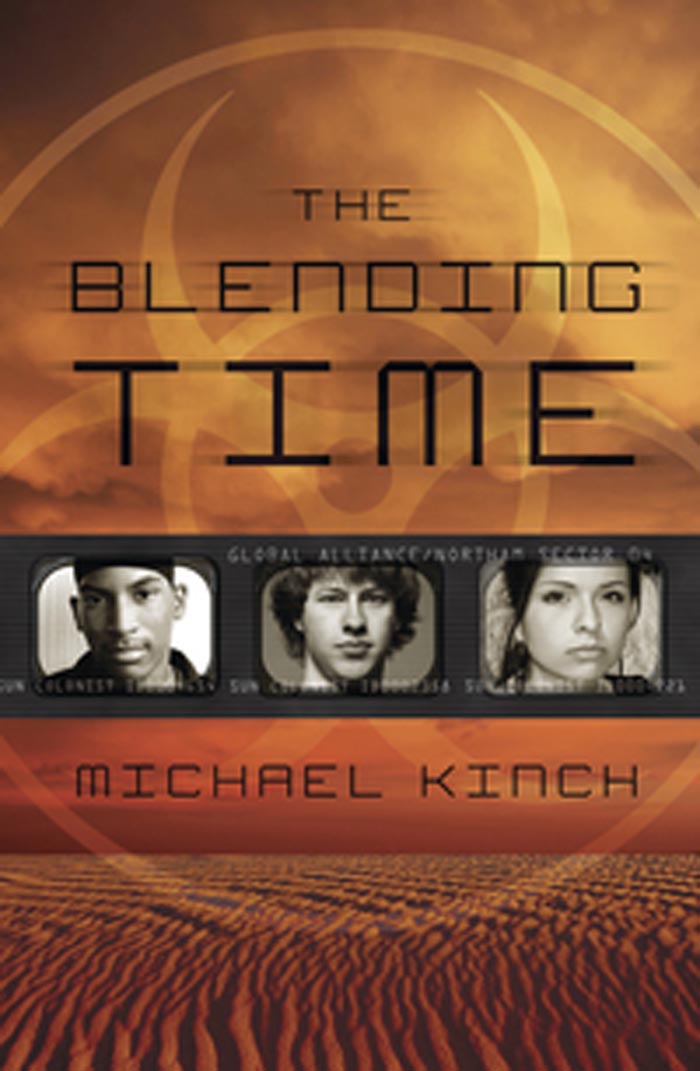
Congratulations on turning age seventeen. You are now ready for placement by the Council government.
"For kids in the year 2069, turning seventeen means they’re ripe for Global Alliance work assignments that range from backbreaking drudgery to deadly canal labor. Trying to survive in a desiccated world that’s been ravaged by plagues, AIDS III, and environmental disasters, three “s’teeners” from very different backgrounds think they’ve gotten lucky. Jaym, Reya, and D’Shay are chosen to be among thousands of blenders whose task is to help repopulate Africa after a solar flare left its people sterile.
But the continent itself—roiling with civil war and mercenaries intent on crushing the blending program at any cost—poses the gravest danger of all. Separated, the three friends struggle to escape horrific situations, somehow reunite, and reach a camp in the mountains that promises salvation from the harsh and threatening world."
"Shocking and unrelenting--Kinch delivers a blistering, no-holds-barred tale of a dystopian future that feels all too real"
(Arthur Slade, Governor General Award-winning author of The Hunchback Assignments.)
Subscribe to:
Posts (Atom)
